Monday, June 18, 2012

Regionality, commodities and brands (brief thoughts on appellations #3)


Anyone who knows about the 1960s cult UK drama series, The Prisoner, will recall the repeated claim by the protagonist that he is not a number. The theme of the programme was the clash between individualism and collectivism, a dichotomy that occurred to me while considering the way some producers choose to stand outside their regional appellation system.

Viewed from one angle, appellations, denominations and regional designations of one kind or another seem to be the natural state of the wine world. In Europe, new regions and sub-regions seem to be given official recognition almost every week. But the picture is hardly different in the New World. Nudge an Australian winemaker and his Pavlovian response will probably be "We need a much greater focus on regionality". Across the Southern Hemisphere and the Americas, vineyards are being graced with brand new appellations of some kind.

Appellations, wherever they are, embody the character of the specific conditions in which the wine is produced. And, for people like Jamie Goode of wineanorak.com, they are the noble opposite of "Commodity wine". This, Goode says is "inexpensive wine purchased in most cases not for its intrinsic qualities but because it serves a purpose, like milk, sugar or instant coffee". "Terroir wine", by contrast, is "any wine that has some sort of link to geography – where the grapes were grown and also local cultural influences"

I tend to look at the word "commodity" rather differently. Going beyond the dictionary definition of "something that is useful or necessary", I prefer the definition from investorwords: "A physical substance, such as food, grains, and metals, which is interchangeable with another product of the same type". This interchangeability - or fungibility - fascinated Marx who wrote that  "From the taste of wheat it is not possible to tell who produced it, a Russian serf, a French peasant or an English capitalist."

Now, experts and enthusiasts will claim that they can always appreciate the difference in taste between two bottles of AC Bordeaux or DO Rioja but, whatever Jamie Goode may think, regionally designated wines like these are undeniably sold as commodities. There are published bulk prices for them and a glance at the website of Global Wines & Spirits reveals how tenders for "Pinot Noir from Burgundy for China" sit alongside "White Generic Wine in bulk needed for Italy". 

In fact, and this is possibly an indigestible suggestion, I'd argue that choosing to fall within an appellation actually raises the risk of being treated as a commodity, for the simple reason that to do so is to put oneself within a fungible group. 

Outside the cosy world of wine, it is interesting how successful producers strive to separate themselves from categories in which others might want to place them. You don't find Apple describing its iPhone as a smartphone or its iPad as a tablet. L'Oreal makes hair colourant, not hair dye; Baileys is "Irish Cream", not a "cream liqueur", Martini prefers to be thought of as "the world's most beautiful drink" than as a vermouth... I could go on.

The cleverest wine producers - to my mind - are the ones that transcend appellations. Wines like Guigal's top Cote Roties, Gaja's Barbarescos, Palacios's Priorats, DRC, Lafite, Petrus, Penfolds Grange, Harlan Estate, Cloudy Bay, Pingus... All of these are bought for themselves and not because of the category in which they fall. There may occasionally be people out there who say, "I fancy a glass of wine from the commune of Margaux... Which shall I have? Palmer? Rauzan Segla? Or Chateau Margaux..? Oh, on balance, maybe I'll go for the Chateau Margaux." But not many...
One person who sees this in the same way as I do is the brilliant cartoonist and blogger, Hugh Macleod, who covered it in a fine blog post"The other day I sho­wed the above car­toon to the owner of a large Ame­ri­can wine impor­ter.'What a lovely grain of sand you are. Too bad you’re lying on the beach.'
 My the­sis that came out of that con­ver­sa­tion: Wine has become a com­mo­dity. But most peo­ple in the wine trade are too self-absorbed with their own wine sch­tick to ack­now­ledge the fact. OTHER PEOPLE’S WINE may already be a com­mo­dity, but NOT OUR WINE, no no no no… Our wine is SPECIAL, yes yes yes yes… If you want to remove the “com­mo­dity fac­tor” from your wine, you first have to admit that yes, you too are also selling a com­mo­dity. And then work from there."

I can't really add much to that - but I look forward to hearing what others think...


Why are appellations like the euro? (Three brief thoughts on appellations #2)

Okay, cards on the table: I've always liked the idea of the Euro. I have no more nostalgia for the lira, escudo and deutschmark than I have for the sovereign, or the louis d'or. And, after living for nearly six years in the heart of Burgundy, I believe in terroir and appellations. A glass of Volnay should taste recognizably different to a Pommard made from vines grown a few metres on the other side of the track. At least to someone with experience of both villages' wines. So, in theory, at least, I believe in appellations.


However... both the currency and the notion of regional designation are human concepts. And for that reason, they don't work. The problem  with the euro is that it cannot sustainably work for both tax-shy Greeks and industrious Germans.


I'm writing this after recent encounters with two bottles of attractively labelled Rioja on sale in Spain for under €3.50, and one with a bottle of Marques de Murrieta Reserva costing over five times as much. The first two were near- worthless wines and the equivalent of Greek euros; the latter was absolutely delicious and, in Euro terms, had German quality and reliability stamped all over it.

The inherent flaw in both appellations and the currency lies in the way they have been allowed to expand. When the first appellations contrôlées were created in the 1930s, the people behind them were mostly the best and best-known producers in their regions. As time moved on, the clubs they launched opened their doors to ever larger numbers of others who did not necessarily share their skills, values or aspirations.


All too often the lowest common denominator gets the upper hand. This arc seems to be the destiny of almost every denominated wine region in the Old and New World. Anyone familiar with Margaux will be familiar with some chateau-owners in that commune's tendency to demand the highest possible yield per hectare for their wines. Priorat was an irrelevant source of communion wine until Palacios and Barbier came along. Then, for a while, this region was transformed into a synonym for fine, expensive reds. Today, Palacios's wines still command a healthy premium but anyone who wants to put a bottle of Priorat on their table should head straight for Lidl in Germany which offers a version at €4.85. Similar stories could be told of the late-comers in Marlborough in New Zealand who contributed to a collapse in the price of wines there.


The only hopes for the Euro, the experts say, is either for all of the countries that use it to be obliged to work to the same strict set of rules ( through some form of central control) or for it to be limited to an inner core" of genuinely like-minded players. There are parallels in the wine world. The appellations that are most coherent are ones like Pauillac (limited in numbers, with shared ambitions and standards) and Buzet (one winery controlling most of the production). Elsewhere, producers try to create some coherence of their own within appellations (the Douro Boys in Portugal; Union des Grands Crus de Chablis in France; VdP in Germany). Alternatively, they do what several countries have chosen to do with regard to the Euro: they decide not to join. The premium, non-appellation Vinos de Tierra in Spain, IGTs in Italy and IGPs and (rather fewer, so far) Vins de France in France strike me as all being rather like the Swedish and Norwegian currencies, relying on their own strengths to survive.


Of course, there's one huge difference between the Euro and appellations; the former has been attacked by critics since it was launched; very few people ever question the logic of lumping hundreds of great, mediocre and humble wines together. Which is why I'm doing so here...

Sunday, June 17, 2012

If there were no customers there would be no whores (Three brief thoughts on appellations #1)

  
The Burgundy negociant Labouré Roi has been charged with fraud. Apparently, some 500,000 bottles of its wine did not contain what the label promised. I have no idea whether the Cottin brothers who run the company are or are not guilty of the crimes of which they have been accused. Over the years I have had some very enjoyable bottles of their wine and several pleasant conversations with them. I have also encountered numerous bottles that were far from impressive examples of their appellations. Most of the latter were sold under supermarket own-labels at prices that were lower than anyone who knows anything about Burgundy would expect to pay.

I remember in particular tasting an attractively priced Gevrey-Chambertin with the buyer of a major UK chain and suggesting that, to my taste, it was not only worse value than the cheaper Bourgogne Rouge and Chilean Pinot Noir he was also selling, it was actually a significantly poorer wine.
"Oh I agree 100%" came his disarming reply.."I'd never drink that stuff myself, but we have customers who'd never pay the right price for Gevrey-Chambertin but want to be able to buy it. So we have to offer one".

Of course, being in the market for a regular supply of the cheapest possible example of a product - any product - that normally commands a premium price does not mean that you condone fraud. Or in the case of meat or fish, that you are turning a blind eye to abusive farming methods. Or, if we were talking about clothes or toys, the use of sweatshop or child labour. But, let's face it, you're certainly increasing the odds of corners having been cut somewhere. As my father used to say, you may not always get what you pay for, but you very rarely get what you don't pay for. There really is no such thing as a free lunch and suspiciously cheap meals should be treated, well, with suspicion.

All of the chatter about the Labouré Roi affair has so far inevitably been about whether fraud was committed, and whether for example that bottle of Gevrey-Chambertin had been cut with basic Bourgogne Rouge. While I wouldn't want for a moment to condone a crime, frankly, that isn't what bothers me. I'm actually more interested in another form of cheating the consumer: of allowing him to create a false and ultimately unsustainable impression of the nature of something and what it should cost. This is just as true of water- filled, factory-farmed poultry or pork as of unfeasibly cheaply-produced bottles of wine from a famous region.

And that, in its essence is one of the fatal flaws in the traditional system of wine packaging and distribution. Everybody knows the " right" price of their favourite brand of toothpaste, car, or whisky. Even members of the wine industry would struggle to say how much a bottle of Chablis or Chianti should cost. Everything depends, they would say, on the producer and the vintage. Which is just fine and dandy for everyone with a comprehensive knowledge of either wine region, and pretty useless to everybody else. Most normal wine drinkers still go out looking for a name they recognise at the most attractive possible price. And for as long as those names belong to appellations with vast ranges of qualities and prices and production standards, they stand a high chance of being confused, disappointed - and on occasion, defrauded.

Sunday, June 10, 2012

Asymmetrical warfare: Ross Brown and private-label wines


"ROSS BROWN, the former boss of the 120-year-old winery Brown Brothers, has attacked [Australia's] leading retailers for flooding their stores with private-label wines, that he said were hollow, copycats and masquerading as real brands..."
Sydney Morning Herald, June 7, 2012
Dear Ross,


We've known each other for a long time - since 1984 I think, when Brown Brothers and Rosemount effectively led the Aussie charge into the UK wine market. Over the years, I've always thought of you as one of the canniest members of the Australian wine industry. You've managed to steer your family company through some pretty choppy waters, you have pioneered wine tourism with an extraordinarily popular destination that's well off most visitors' beaten track, and following in your father's footsteps you've headed a varietal innovation program that is arguably unequalled by any similarly-sized company in the world. And, of course. you helped to launch Australia's First Families of Wine, at whose event you raised the issue of the private-label brands.


You  called the private labels "hollow logs", because, in your words "they masquerade as brands but in fact they are just a label which has none of the values that traditional family wine companies bring to the market''. According to the news report, you went on to say that if private labels were allowed to dominate, traditional wine companies would be disenfranchised, and the future of the Australian industry as a whole would be under threat.


I've been interested in the subject for a while - though not in the context of the domestic Australian market; they are a growing trend across the globe. When we first met, I was a consumer wine writer - for the London Sunday Telegraph - and co-chairman of the then embryonic International Wine Challenge. In those days, like my colleagues, I was obsessed with finding great new wines and especially ones that offered value for money. Some came from companies like yours; some from corporately-owned businesses and some bore supermarket own-labels, though not what we now know of as private labels. Back then, we were more likely to be looking at "Sainsbury's Claret". While, I'm pretty sure that the long-term thinking implied by family ownership is far more ideal for a wine business than anything that involves shareholders obsessed with latest quarterly results, I'm afraid I can't subscribe to it being an absolute good. There are several Bordeaux chateaux I can think of that profitably make much better wine now they are owned by insurance companies, and plenty of family-owned wineries whose quality is annually compromised by concerns over cash flow. So, while it is obviously important to you at Brown brothers, I'm going to leave the family or corporate question for another day.


Far more important is the issue of whether private labels are or are not really brands and whether they threaten your industry. As you  know, Ross, in recent years, I've stopped writing for consumers and running competitions, and moved into producing wine myself - with two partners and a great team of winemakers in southern France - and into a research consultancy called DoILikeIt?, also in partnership, with your old friend Hazel Murphy and Judy Kendrick. This has given me a rather different view of the world from the one I had a decade ago. As a producer, I know what it is like to discuss prices and marketing contributions with big retailers and to see my bottles on shelves at ludicrously high off-promotion and ludicrously low on-promotion prices - and been able to do nothing about it, other than to seek other  routes to market. As a researcher, I've also spent time learning about what ordinary consumers actually know and think about wine. 

Wearing my producer hat, I agree that competing against private labels is what I'd term asymmetric warfare, like a modern soldier  fighting against a suicide bomber. The nicely labelled bottle of Prilab (my just-invented Private Label) goes through none of the hoops to get on the shelf that your wine or mine might, and there's every chance that the contents are a copy of something we went to a lot of trouble and risk to launch ourselves. But, as I regularly have to remind my five-year-old daughter, life isn't fair. Asymmetric warfare goes back to the earliest conflicts when one tribe had bigger clubs than the other: more recently, the Brits had no defence against German V2 rockets; the Japanese had no atom bombs. In the wine business, you at Brown Bros have to compete internationally against the muscle of bigger companies like Gallo and Constellation, but smaller, ill-funded wineries have to match up against you and the distribution strengths you have built up over the years. Back in the 1990s, when everybody loved the UK retail chain Oddbins, any Champagne brand wanting to sell its wine there did so in the knowledge that the staff were incentivized to push Mumm and Perrier-Jouet which both belonged to Seagrams, Oddbins' then owners. Indeed the very survival of Oddbins as the company it was, depended on its success at distributing Seagrams products.

Of course Mumm and Perrier Jouet were not private labels, but nor, in the minds of UK consumers at least, are brands like Ogio and Etienne Dumont. I can't talk about any private labels Coles and Woolworths may be selling in Australia, but we did some research in Britain in which we discovered that more regular wine drinkers recognised an Ogio label from which the name and other text had been removed than could identify labels from Guigal, Louis Jadot and Cloudy Bay that had had similar treatment. Ogio, a Tesco-exclusive, is currently the 16th best-selling brand in the UK. Etienne Dumont, Sainsbury's private label Champagne is either the best or second-best-selling Champagne in the UK, depending when you're counting. Some private labels may be hastily-knocked up, short-lived shelf-fillers; others develop lives of their own and grow into "proper" brands, at least in the eyes of the consumers who buy them

If it looks, quacks and flies like a duck, I'm afraid it probably isn't an owl. Ogio may have begun life as a private label but I can think of a least one big wine company that would rather have it in its portfolio than some of the turkeys (sorry about all these birds) it's struggling to distribute profitably.

Ross, we live in a very changed world. Family ownership and heritage have value, but so does branding and, even more crucially, distribution. Once, companies that owned clothing brands manufactured clothes; Tommy Hilfiger changed all that. One of the youngest brands on the market and without a factory of any kind, it was more valuable (based on its sale for $3bn in 2010 to the owner of Calvin Klein) than long-established French fashion houses. 

One reason why some wine private labels have been so successful is the relative feebleness of the real ones. It would be far, far more difficult to launch a strong private label gin or ale; proper spirits and beer brands are just too strong. So, Ross, I'd humbly (well, not too humbly) suggest that, rather than complain about something that is not going to go away (supermarkets will do what suits them when all is said and done), you'd be better advised to focus on building your own fan base. The nearly 20,000 Facebook Brown Bros followers is not bad, but Gallo's Barefoot Cellars' 350,000 "likes" gives you a slightly higher target to aspire to. Similarly, Brown Brothers deserves more than 2,500 followers on Twitter. Your story - including the family-ownership - deserves to be told, and heard by a far wider number of people. We recently proved the power of social media when we launched WINESTARS, with almost no time and very little budget. I recently learned of a US (non family-owned) company that has built sales of over 1m cases across two new brands, exclusively through social media ("we do everything we can to keep them out of the hands of the traditional critics and media" was the comment).

The wonderful thing about social media, when properly and cannily used, is that it can reverse the balance of power: David's catapult versus Goliath's size.

With my very best wishes


Robert


Friday, June 08, 2012

Location, Location, Location... Or why moving the London International Wine Fair would not be the answer

As someone who has made no secret of his fears for the London International Wine Fair - unless some very big changes are made - I have inevitably  been at the receiving end of many visitors' and exhibitors' comments. Extraordinarily, to judge by the majority of them, the only thing the organisers need to do to revive the event is to shift it back into the centre of London. The problem with LIWF is that it's out in Excel, a difficult place to get to and absolute hell when the trains aren't working.

There's no denying the appalling nature of the UK capital's transport system and it's a good thing that there aren't any major sporting events due to be held here this summer, but to suggest that this is a really significant reason for the LIWF's problems is frankly ludicrous. Some 24,500 publishers managed to attend this year's London Book Fair, despite the insuperable hazards of the DLR, 33,000 caterers were at Hotelympia and a massive 48,000 people managed to get to last year's World Travel Market at Excel and a similar number is expected this year. 

So, either the wine world is simply more precious than the travel, catering and publishing professions, or the UK wine trade doesn't warrant a trade fair, or the one we've got needs some attention. Now, given the fact that an extraordinary number of members of the international wine trade somehow manages  to make its way to Cheshunt when it wants to present its wines to Tesco, Leeds for Asda, or Bracknell for Waitrose - to name but three big UK retailers - none of which is within a convenient  distance from Central London, I'd have to say that it's either the UK wine market or the fair that has a problem. Or both.

The imaginary Indian wine boom

Hold the front page! Indian wine taxes finally due to fall! Stand by for a China-style Indian wine boom!

Except that it isn't going to happen. Or at least not yet anyway. First there's the inconvenient little truth that every time a wine tax goes down in India, another one is levied to prevent wine from becoming affordable. But second, there's the rather larger fundamental fact that there is an anti-alcohol lobby in India that makes its counterparts in other countries look like pygmies.

This is the only nation that includes a call for total prohibition in its constitution. And lest anyone imagine that this is a long-forgotten joke by the original authors of that document, at the end of 2006, two members of India’s Supreme Court - Justices SB Sinha and PK Balasubramanyan – wrote, in a ruling on a case involving the payment of Bombay distillery fees, that  "Article 47 of the constitution clearly casts a duty on the state at least to reduce the consumption of liquor in the state, gradually leading to prohibition itself,

“It appears”, they continued, “to be right to point out that the time has come for the states and the union government to seriously think of taking steps to achieve the goal set by Article 47 of the constitution.". There is little likelihood of total prohibition being introduced, but nor is there much chance of anyone repealing the “Dry Day” legislation that effectively stops any kind of wine retailing on up to a dozen or more days per year. In Delhi, alcohol is still banned for anyone under 25, while the 1.3m inhabitants of Wardha District in Maharashtra have to wait a further five years until they are 30 before they can have a drink.

SB Sinha and PK Balasubramanyan were principally talking about spirits, of which many Indians, including supposedly teetotal Muslims are very fond. Very, very few people in India have actually been infected by the wine bug. Wealthy Indians who readily pay outrageous sums for luxury Cognacs or whiskies balk at splashing out on the top Bordeaux that fill the cellars of their British, American and Chinese counterparts and middle class Indians generally prefer whisky. India has an infant wine industry, but most of it is unprofitable and in the hands of people with little understanding of the business. It is revealing that the majority of the domestic production is centered on the table-grape growing region of Nasik, close to Mumbai, and within the control of the Maharashtra regional government which has offered large incentives to anyone wanting to invest in winemaking. There is very little proper retail infrastructure (most wine that is sold outside restaurants and hotels is still traded from non-air-conditioned shopfronts) and little real progress in sommelier training. London auction rooms rarely see Indian hands waving in competition with Brits, Americans and Chinese when top wines come under the hammer.

After several visits and after chairing three International Wine Challenges in India, and despite many absurd conversations with people who imagined that the subcontinent really does have a chance of competing with China to become a giant wine market in near future, I have been pretty clear where I stood.

I received further confirmation, as chair of the London International Wine Fair Conference in the excellent presentation by Spiros Malandrakis of Euromonitor on the BRICs. Despite its huge population and thriving economy, India, Malandrakis explained, is contributing negligeably to the growth in wine consumption in the developing world.

Just over a week after hearing those figures I was at Vinexpo Hong Kong talking to members of the Union des Grands Crus de Bordeaux who travelled there via the subcontinent. They had, they said, held reasonably successful tastings, but there was no real buzz. Other chateau representatives who had opted to travel via Brazil were far more energised by what they had seen.

But, say the optimists, If the taxes were to fall, surely that buzz would emerge, as it has elsewhere. After all, the British love fine wine and the historic links between the two countries and the use of English by educated Indians must count for something. Mustn't it? But if high excise and import duties certainly don't help, they are not necessarily an insuperable barrier. A passion for wine - or even just an eagerness to show off with a few great bottles  is rather like love. It will find a way. Brazil actually also faces obscenely high taxes on wine, but the market is booming. Until now, that boom has been in local and Portuguese (through old colonial connections) wines and bottles from neighbours like Chile and Argentina which belong to the same tariff-free zone. Now, there seem to be growing opportunities for other countries.

I'm sure that India will develop a wine market eventually and I know that people like Simon McMurtry of Direct Wines who has just invested in the Wine Society of India will be doing his best to accelerate the trend, but my money is on it taking at least five to ten years, by which time China will almost have certainly taken an insuperable lead.

Won't get fooled again

An adapted version of a column in the current edition of Meininger's Wine Business International

This is the story of a rather wealthy Hong Kong-based businessman we'll call Aaron (choosing a random name at the top of the alphabet).

Aaron is a regular En Primeur buyer, who places an order for a reasonable number of very top end wines every Spring. Like many other people, he did not get nearly as many bottles of 2009 as he would have liked, but overcame his disappointment and readily took the call from his regular merchant 12 months later. Demand for the 2010s he was told, was once again going to be high; he had the choice of drawing up a wish list with no guarantee of getting anything on it, or he could "buy forward". This option increased the chances of securing the wine, though possibly at a far higher price than he might want or expect to pay.

Aaron replied that he liked neither of these options. What he wanted, as a regular customer, was for the merchant simply to let him know what he could have and at what price. At this point there must have been a misunderstanding because the merchant presumed that Aaron was placing a firm forward order. A few weeks later, he phoned to say "I have some really good news! You're very lucky to have got all the wines you wanted, but I'm afraid they were a bit dearer than we expected". Aaron took one look at some of the prices and said "No thank you very much!"

"But you have to take them" came the response, "You ordered them."

"Surely", Aaron countered, "If I was so incredibly lucky to get them, you'll have a waiting list of other customers who'll be fighting to take those wines off your hands".

"You ordered them" came the obdurate reply. "You take them".

Aaron pointed out that his understanding of the law led him to believe that the merchant would have a very hard and expensive time trying to force him to do so, before finally acquiescing and taking half of the cases - and vowing never to have anything to do with that company again.

Aaron was not alone in not enjoying the experience of buying 2010 Bordeaux. Indeed, from what I understand, there are rather a lot of Chinese in Hong Kong and elsewhere who have not taken up their orders, not to mention a few high profile European merchants who have opted not to take up their allocations either.

The picture in 2011 is worse. Far worse. According to one negociant, this was "the worst En Primeur campaign in 30 years" with only 20% of the wine having found buyers. Call him or one of his competitors today and you might even be offered the latest vintage of some of the first growths that were so famously hard to obtain just twelve months ago.

"What I really resent," Aaron says "is being taken for a fool". And that is precisely the mood of many Chinese buyers. These are not unsophisticated people. Almost none of them adds Coke or any other soda pop to their Bordeaux and even if they can't speak English, they are often very well informed about what is being written and said about them in that language. When France's Nouvel Observateur revealed last year that "Asian millionaires' thirst for the best Bordeaux wines has sent prices skyrocketing, and the most prestigious Châteaux have been turning astronomical profits as a result.", they heard about it. When Time magazine article, in March 2011 talked of a "China-driven bubble" and offered various questionable explanations for the Chinese readiness to pay over the odds, including the story that the king of Thailand was prescribed red wine by his doctor, they heard about that too. Imagine what it feels to walk down a street and to overhear your neighbours gossiping about how much you've overpaying for your rent; that's precisely the way the Chinese are feeling today.

There are all sorts of reasons for paying over the odds for anything, as anyone in the luxury business knows, but essentially they all boil down to the buyer wanting or needing to make the transaction. 2009 Bordeaux was desirable wine, and like 1982 for a generation of new American wine drinkers, a great first step onto the wine ladder for Chinese novices. The "need" to buy 2010 and still less 2011 is far harder to demonstrate. It remains to be seen whether 2010 is or is not the finer vintage, as some UK critics claim, but without the head of steam 2009 received from Parker et al, it was not a must-buy. And certainly not at the prices that are being asked for 2011.

The recent Union des Grands Crus de Bordeaux  tasting at Vinexpo Hong Kong should give the Bordelais pause for thought. Two  years ago, a mass of Chinese tasters eagerly gathered to sample the 2006 and 2007 vintages; the words 'feeding frenzy' were used. This time, the wines on offer were 2009s. In other words, this should have been a very memorable event: the vintage of the century being presented in Hong Kong, the current hub of the wine world. And yet... it seemed to be far, far calmer than in 2010. The room was admittedly larger, so it was hard to judge whether there really were fewer tasters than two years earlier, but the fact that this was even being discussed speaks volumes; there certainly weren't more.

In the same building, in an admittedly far smaller room, Chinese tasters were queuing to taste examples of Grand Cru Chablis. In 2010, it is very doubtful whether the Union des Grands Crus de Chablis could have attracted any kind of audience. China was not interested in white Burgundy. Today it is. And it's increasingly interested in red Burgundies, white Germans, New Zealand Gewurztraminers and all sorts of  other fare.

If the producers in these countries treat the Chinese with respect, they may well find that the relationships they are building may last a little longer than Aaron's has with his London wine merchant.

Tuesday, June 05, 2012

What's in a name?

Could a beer company successfully launch a wine under its own brand? A Carlsberg Cabernet perhaps? Or an Adnams or Anchor Steam Albariño? Until quite recently, I'd have thought the question preposterous; now I'm far less sure. After all, it wasn't so very long ago that I'd have dismissed the notion of a wine company launching a vodka or a brewery selling a cider.

But Cupcake, last year's fastest growing wine brand in the US has indeed released an award-winning range of vodkas and AB InBev's Stella Artois Cidre has just recorded £36m in UK supermarket sales during its first year on sale. When Cidre was first launched, many industry experts dismissed its chances, especially given the strength of Magners its main competitor. But just under half of the Cidre sales were incremental to the cider and beer categories. The value of Magners sales actually grew by 21% by value across the same period.

But, I hear you say, beer and cider are quite different to wine. Well, up to a point, would be my response. When people drink best-selling sweet Californian "white" rosé, are they really drinking "wine" as traditionalists understand the term? I ask because, while researching consumer attitudes to a 5.5% pink South African wine with added flavours, few recognised that it was not one of those Californians. 
 
Booming sales of low-alcohol flavoured wines like First Cape's Cafe Collection from the wine aisles of UK supermarkets suggest that in Britain at least, there's plenty of flexibility in the way that consumers view inexpensive "wine".


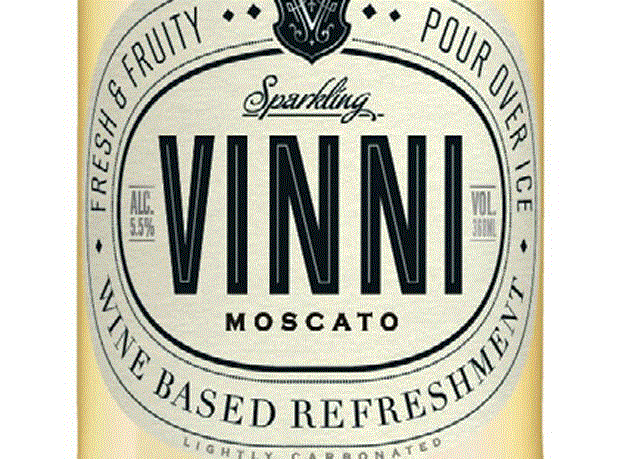
Another example of the way that lines are being blurred comes with VINNI, a new launch by McGuigan (disclosure: a company for which I have provided consultancy and research). Unlike Cafe Collection, VINNI is technically and legally a wine - a 5.5% Moscato - but it comes in a pint-sized (568ml) bottle and has a label that describes it as "wine based refreshment". Tesco, the UK's - and the world's - biggest wine retailer evidently believes in VINNI, having just decided to list it in all of its stores.
It's rose, but it's not rose wine


Now please don't misunderstand me. I'm not saying that drinks like these are going to take over the wine market, but I'll lay a bet that - at the high-volume, lower end of the price spectrum - they will be increasingly important. And they deserve at least as much attention as the "Natural" wines that have commanded so much attention.

Since posting this I've discovered that Adrian Atkinson of Pernod Ricard asked this very question at a recent conference. Credit to him for raising it first!

Thursday, May 24, 2012

Thoughts from Day 2 of the London International Wine Fair

First things first: despite being smaller in size and - seemingly - audience, the London International Wine Fair was a busier event than I and many others expected. Some exhibitors said they had had a very good couple of days, though, worryingly for the organisers, so did some producers who exhibited last year and merely turned up this time. As one said. "We saw all the same people, and saved a fortune".

The imbalance of exhibiting countries was also striking: huge stands for Croatia, Hungary and Slovenia (all of whose wines are invisible in the UK) and a vastly reduced one for Australia and none at all for New Zealand.

Also striking was the change in the role of the event. Five years ago, people came to the LIWF to find out what they might be seeing in their countries today. Now, those same people are noting how the UK has slipped from being a leader into the role of follower. Today, when it comes to packaging, Finland is taking the lead, while wine styles are being pioneered in the US. British professionals may say, that they don't want brands with names like Cupcake and Flipflop; that they don't think Moscato (an 18-month old soaraway success on the other side of the Atlantic) will work here; and that British consumers won't take to sweet red blends... But there is nothing on offer in London to suggest that the UK has any fresh alternatives to these US trends. The message from the LIWF is "business as usual" which, when you consider how little money is being made in the UK wine business, is hardly encouraging.

Hopefully Tesco's Dragon's Den stand and, our WINESTARS initiative which takes off tomorrow at 13.30 UK time have added a note of freshness to the proceedings. I'm certainly excited by the quality of the WINESTARS entries, the passion shown by their producers and their readiness to fly across the world at short notice to take part. With any luck, their efforts will be repaid with commercially rewarding listings.


Friday, May 18, 2012

The irrelevance of the country and region of origin of a wine (to most people)

The following post is a slightly amended version of one I posted yesterday headed "The irrelevance of terroir (to most people)."  Many of the nearly 1000 readers took the reference to "terroir" very literally, so I'm reposting it here, replacing that term with "origin" or similar and put all of these in italics. I think and hope the meaning will be unchanged.


How much do you care about the origin of what you eat and drink? How much does anyone really care about it? I know for a fact that Heston Blumenthal has a patchy interest in it, as do some highly distinguished members of the wine industry in places like Burgundy, Bordeaux and Champagne as well as the heads of several award winning wine companies.. Whatever they might say to the contrary. As for normal consumers, even the ones who take a keen interest in what they eat and drink, pay it very little attention.

Now, I know that even by my standards this is a contentious statement, but I have tangible evidence to support my case.

So, here goes. The country and region where it comes from is undeniably crucially - influential in the way a wine tastes. 

But this factor is also not limited to wine. Malt whiskies are influenced by the water from the local spring; coffee and tea to the humidity and altitude of the places where the beans and leaves are grown. Chocolate, cheese, honey and perhaps most clearly of all, olive oil, all bear the imprint of the place they come from. Olive oil comes top of this list because, as Chiara Planeta who is passionately involved with the award-winning oils produced by her family company in Sicily, points out, if you make it honestly, there's almost no human intervention. You simply harvest the olives - earlier rather than later, ideally - and extract the oil as quickly as possible after they leave the tree.

Fine olive oil is, in its way, as fine and noble a product as any wine, and just as ancient. And most people take zero interest in where it comes from. When I say "most people", I'm not talking about ignorant British or American consumers for whom olive oil is a foreign ingredient; I'm talking about the Sicilians who do their shopping down the road from the olive groves and use huge amounts of olive oil every day. Not only do they not take any interest in which part of Sicily their oil comes from, most don't even really care whether the stuff on their salad is actually Italian. Most of the oils on sale in the two supermarkets I visited have brand names like Bertolli and are bottled in Italy but generally hail from groves in Spain or Greece or Portugal. In each of the shops, Sicilian oil represented a tiny minority of what was on offer. Sicilian housewives evidently choose their oil on the basis of its house style and price. In one little shop in a small village, there were two oils on the shelf: a Bertolli at five euros and a Sicilian for four euros fifty. The shopkeeper approved of my choice of the local oil, but evidently still needs to stock the global brand.


This focus on style is even more evident elsewhere in Italian food shops. Italians care about coffee. And I'd say they probably care more about it than people in many other countries. But, here again, they show no interest in where it comes from. What they buy is the brand - Illy, Lavazza, Hag etc - and the level of strength which is helpfully indicated in at least one set of shops, by a set of colour codes. A British shopper used to the Costa Rican, Colombian and Brazilian coffees on offer in their local store would be staggered at the absence of any reference to provenance. What Sicilian shoppers buy is various versions of what Anglo-Saxons know as "Italian-blend".


The wall of coffee - and the Lavazza reference to its multi-country sourcing
I did see one reference to country: almost every Italian store has Lipton's English Breakfast Tea. Sadly, I was unable to discover precisely where in these lovely islands, the tea plantations might have been situated.

Now, at this point, I can hear a number of people angrily pointing out that their Italian friends DO care about tea and coffee and olive oil, and that the people who shop in supermarkets are just the ignorant masses. To which I would counter that these are precisely the same masses we expect to pay attention to wine terroir.

But here I return to my original contentious contention that a great many people whose livelihoods depend on a belief in where a wine comes from have absolutely zero interest in the way regionality applies to coffee. I know this because they have demonstrated it by their actions: they have spent their money - a lot of money in some cases - on a Nespresso machine - or one of its competitors.

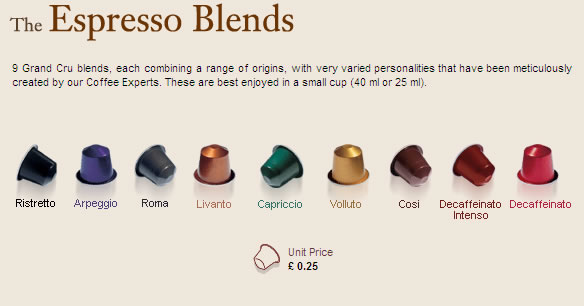
Now, for anyone who has led a sheltered life, I'll briefly explain that these are devices that were developed at huge expense by Nestle to enable ordinary mortals to produce espresso coffee of a guaranteed style, quality and consistency. The system is highly ingenious: the coffee comes in little metal pods (“capsules”) whose colours and shape show the same kind of design flair as anything to come out of Apple or Bang & Olufssen. All you have to do to be sure of getting your desired cup of caffeine (or decaffeinated, naturally) is to choose the colour that relates to the style you want, pop it into the machine and press the button. Buying a Nespresso machine is a little like getting married: the expression “forsaking all others” springs to mind as one realizes that, until the patents run out, the only place one can buy pods that fit in it is directly from Nespresso shops or online.


The range is not huge. Just three of the pods are described as “Pure Origin” – Dulsão do Brasil, Indriya from India and Rosabaya de Colombia. The others - Ristretto, Arpeggio, Roma, Decaffeinato Intenso, Livanto, Capriccio, Volluto, Cosi, Fortissio Lungo, Vivalto Lungo, Finezzo Lungo and Decaffeinato Lungo – could come from anywhere coffee is grown. They conform to the explanation on an Italian Lavazza packet that the origin may vary in order to maintain the consistency of the product.

For a while, I tried to keep a rough tally of the number of Nespresso machines I encountered and the places where I found them. But after I hit my fourth Bordeaux chateau, third Champagne house and fifth head of a UK wine company, I gave up. They are becoming ubiquitous, with sales rising by 20% per year over the last decade. According to Nestle, over 21% of all espresso machines are now Nespressos, while a number of alternatives such as Sara Lee’s Senseo and Kraft’s Tassimo all make their own inroads into the tradition of selecting one’s own coffee from a range on a retailer’s shelf.

I must confess to having rather mixed feelings about these machines. I don't like the idea of having to buy all my coffee from one producer; I don't like being restricted to a limited range; I don’t like the fact that they cost up to thrice what one might pay for good coffee purchased by the bag; and I don’t like the fact that all those pods have to be recycled - or sent to landfill.

On the other hand I am really rather grateful for the fact that almost everywhere I go, people offer me pretty good coffee, and don't have to go to any great trouble to prepare it.

Now I know that Nespresso machines are, in the words of one coffee lover, treated as the devil's work by his fellow enthusiasts. And I know that there is a keen band of people out there who care passsionately about the coffee they drink, choosing their beans with care and possibly even doing the roasting themselves. But these are an infinitely tiny minority of coffee drinkers.

Most people appreciate the simplicity of buying by style and colour. So how does this apply to wine? Well, people are increasingly purchasing their wines by brand rather than country (think of Lindemans, Blossom Hill and Ogio in the UK and think of all those bottles of“Californian” branded wines whose contents are sourced from Chile or France.

So far, they haven’t often been offered the chance to use a colour code when choosing their wine, but I can see this option developing too. I have recently done some interesting consultancy work with the Australian brand McGuigan on a range of colour-coded “Classic” wines that applies Nespresso thinking and the line "What's your style?". Some 9,000 people scanned a QR Code in a magazine - and just under 3,000 very happily shared their tastes for “fresh”, "spicy", "intense" etc. The McGuigan wines are from Australia, but I'd be surprised if a similar concept could not be successfully applied by a multi-national brand such as Ogio.
The place something comes from is either important - commercially speaking - or it's not. And, judging by the way people, ranging from Sicilian housewives to Bordeaux chateau owners vote with their wallets, there are plenty of instances in which it really does not matter at all. And least anybody suggest the contrary, the argument that origin matters more to wine than to, say, coffee is intellectually indefensible. It's like saying that one can be prejudiced against a person's religion but not her skin colour. 

Traditionalist wine folk will hate this theme and say that people really should care about where a wine comes from, but I’d recommend that they wake up and smell the (origin-irrelevant) coffee.


In response to comments that this post lacks a conclusion, I've decided to add one here:


People like me have historically applauded retailers for the diversity of their ranges - and lamented when they, and producers, have moved towards simplification. We have wilfully overlooked the fear that the "Wall of Wine" engenders in a huge number of consumers. I now believe that we have been talking to ourselves (an endemic problem in our industry). Perhaps it is time - at the more basic, daily-drinking end of the market - for producers and retailers to embrace options such as doing away with vintage variation and introducing colour/style coding as a means of making daily drinking wine as easy to buy as coffee,


Thursday, May 17, 2012

The irrelevance of terroir (to most people)

How much do you care about terroir? How much does anyone really care about terroir? Now, just to make sure we are talking about the same thing, my definition of 'terroir' includes the soil, aspect, altitude and microclimate that all essentially contribute to individuality. And, if we agree on that, I know for a fact that Heston Blumenthal has a patchy interest in it, as do some highly distinguished members of the wine industry in places like Burgundy, Bordeaux and Champagne as well as the heads of several award winning wine companies.. Whatever they might say to the contrary. As for normal consumers, even the ones who take a keen interest in what they eat and drink, pay it very little attention.

Now, I know that even by my standards this is a contentious statement, but I have tangible evidence to support my case.

So, here goes. Terroir definitely exists and is undeniably crucially - influential in the way a wine tastes. It is not - despite what some chauvinist Frenchmen have suggested - exclusive to France. Vineyards in places from Turkey to Tasmania have individual, influential terroirs. With me so far?

But terroir is also not limited to wine. Malt whiskies are influenced by the water from the local spring; coffee and tea to the humidity and altitude of the places where the beans and leaves are grown. Chocolate, cheese, honey and perhaps most clearly of all, olive oil, all bear the imprint of the place they come from. Olive oil comes top of this list because, as Chiara Planeta who is passionately involved with the award-winning oils produced by her family company in Sicily, points out, if you make it honestly, there's almost no human intervention. You simply harvest the olives - earlier rather than later, ideally - and extract the oil as quickly as possible after they leave the tree.

Fine olive oil is, in its way, as fine and noble a product as any wine, and just as ancient. And most people take zero interest in its terroir. When I say "most people", I'm not talking about ignorant British or American consumers for whom olive oil is a foreign ingredient; I'm talking about the Sicilians who do their shopping down the road from the olive groves and use huge amounts of olive oil every day. Not only do they not take any interest in which part of Sicily their oil comes from, most don't even really care whether the stuff on their salad is actually Italian. Most of the oils on sale in the two supermarkets I visited have brand names like Bertolli and are bottled in Italy but generally hail from groves in Spain or Greece or Portugal. In each of the shops, Sicilian oil represented a tiny minority of what was on offer. Sicilian housewives evidently choose their oil on the basis of its house style and price. In one little shop in a small village, there were two oils on the shelf: a Bertolli at five euros and a Sicilian for four euros fifty. The shopkeeper approved of my choice of the local oil, but evidently still needs to stock the global brand.


This focus on style is even more evident elsewhere in Italian food shops. Italians care about coffee. And I'd say they probably care more about it than people in many other countries. But, here again, they show no interest in where it comes from. What they buy is the brand - Illy, Lavazza, Hag etc - and the level of strength which is helpfully indicated in at least one set of shops, by a set of colour codes. A British shopper used to the Costa Rican, Colombian and Brazilian coffees on offer in their local store would be staggered at the absence of any reference to provenance. What Sicilian shoppers buy is various versions of what Anglo-Saxons know as "Italian-blend".


The wall of coffee - and the Lavazza reference to its multi-country sourcing
I did see one reference to country: almost every Italian store has Lipton's English Breakfast Tea. Sadly, I was unable to discover precisely where in these lovely islands, the tea plantations might have been situated.

Now, at this point, I can hear a number of people angrily pointing out that their Italian friends DO care about tea and coffee and olive oil, and that the people who shop in supermarkets are just the ignorant masses. To which I would counter that these are precisely the same masses we expect to pay attention to wine terroir.

But here I return to my original contentious contention that a great many people whose livelihoods depend on a belief in wine terroir have absolutely zero interest in the way regionality applies to coffee. I know this because they have demonstrated it by their actions: they have spent their money - a lot of money in some cases - on a Nespresso machine - or one of its competitors.

Now, for anyone who has led a sheltered life, I'll briefly explain that these are devices that were developed at huge expense by Nestle to enable ordinary mortals to produce espresso coffee of a guaranteed style, quality and consistency. The system is highly ingenious: the coffee comes in little metal pods (“capsules”) whose colours and shape show the same kind of design flair as anything to come out of Apple or Bang & Olufssen. All you have to do to be sure of getting your desired cup of caffeine (or decaffeinated, naturally) is to choose the colour that relates to the style you want, pop it into the machine and press the button. Buying a Nespresso machine is a little like getting married: the expression “forsaking all others” springs to mind as one realizes that, until the patents run out, the only place one can buy pods that fit in it is directly from Nespresso shops or online.


The range is not huge. Just three of the pods are described as “Pure Origin” – Dulsão do Brasil, Indriya from India and Rosabaya de Colombia. The others - Ristretto, Arpeggio, Roma, Decaffeinato Intenso, Livanto, Capriccio, Volluto, Cosi, Fortissio Lungo, Vivalto Lungo, Finezzo Lungo and Decaffeinato Lungo – could come from anywhere coffee is grown. They conform to the explanation on an Italian Lavazza packet that the origin may vary in order to maintain the consistency of the product.
For a while, I tried to keep a rough tally of the number of Nespresso machines I encountered and the places where I found them. But after I hit my fourth Bordeaux chateau, third Champagne house and fifth head of a UK wine company, I gave up. They are becoming ubiquitous, with sales rising by 20% per year over the last decade. According to Nestle, over 21% of all espresso machines are now Nespressos, while a number of alternatives such as Sara Lee’s Senseo and Kraft’s Tassimo all make their own inroads into the tradition of selecting one’s own coffee from a range on a retailer’s shelf.

I must confess to having rather mixed feelings about these machines. I don't like the idea of having to buy all my coffee from one producer; I don't like being restricted to a limited range; I don’t like the fact that they cost up to thrice what one might pay for good coffee purchased by the bag; and I don’t like the fact that all those pods have to be recycled - or sent to landfill.

On the other hand I am really rather grateful for the fact that almost everywhere I go, people offer me pretty good coffee, and don't have to go to any great trouble to prepare it.

Now I know that Nespresso machines are, in the words of one coffee lover, treated as the devil's work by his fellow enthusiasts. And I know that there is a keen band of people out there who care passsionately about the coffee they drink, choosing their beans with care and possibly even doing the roasting themselves. But these are an infinitely tiny minority of coffee drinkers.

Most people appreciate the simplicity of buying by style and colour. So how does this apply to wine? Well, people are increasingly purchasing their wines by brand rather than country (think of Lindemans, Blossom Hill and Ogio in the UK and think of all those bottles of“Californian” branded wines whose contents are sourced from Chile or France.

So far, they haven’t often been offered the chance to use a colour code when choosing their wine, but I can see this option developing too. I have recently done some interesting consultancy work with the Australian brand McGuigan on a range of colour-coded “Classic” wines that applies Nespresso thinking and the line "What's your style?". Some 9,000 people scanned a QR Code in a magazine - and just under 3,000 very happily shared their tastes for “fresh”, "spicy", "intense" etc. The McGuigan wines are from Australia, but I'd be surprised if a similar concept could not be successfully applied by a multi-national brand such as Ogio.
The place something comes from is either important - commercially speaking - or it's not. And, judging by the way people, ranging from Sicilian housewives to Bordeaux chateau owners vote with their wallets, there are plenty of instances in which it really does not matter at all. And least anybody suggest the contrary, the argument that terroir matters more to wine than to, say, coffee is intellectually indefensible. It's like saying that one can be prejudiced against a person's religion but not her skin colour. 

Traditionalist wine folk will hate this theme and say that people really should care about teroir, but I’d recommend that they wake up and smell the (origin-irrelevant) coffee.


In response to comments that this post lacks a conclusion, I've decided to add one here:


People like me have historically applauded retailers for the diversity of their ranges - and lamented when they, and producers, have moved towards simplification. We have wilfully overlooked the fear that the "Wall of Wine" engenders in a huge number of consumers. I now believe that we have been talking to ourselves (an endemic problem in our industry). Perhaps it is time - at the more basic, daily-drinking end of the market - for producers and retailers to embrace options such as doing away with vintage variation and introducing colour/style coding as a means of making daily drinking wine as easy to buy as coffee,


Thursday, May 10, 2012

Why ask why? (an offering from Seth Godin's Blog)

Why ask Why?

"Why?" is the most important question, not asked nearly enough.
Hint: "Because I said so," is not a valid answer.
  • Why does it work this way?
  • Why is that our goal?
  • Why did you say no?
  • Why are we treating people differently?
  • Why is this our policy?
  • Why don't we enter this market?
  • Why did you change your mind?
  • Why are we having this meeting?
  • Why not?

All relevant to the wine industry, a place where Whies of every size are slaughtered daily - if they even get to be born. 

Wednesday, May 09, 2012

Looking back... four decades of vinous evolution

An adapted version of a piece written for the 500th edition of Delwine in India)

I have to pinch myself sometimes to think that I can remember when colour televisions, calculators and mobile phones and even fax machines were all expensive novelties that I used to admire in the homes of other, wealthier or simply more adventurous, families.


Mobile phone and Wolf Blass Cab - both 1983 vintage

Another novelty, I remember from those early days – of the mid 1970s – was ‘real’ French wine. This was the time when Britain became – at least nominally – part of Europe and subject to its vinous legislation. Suddenly, the days of selling Spanish Sauternes, and of bottling the same North African red as Beaujolais, Nuits St Georges and Chateauneuf du Pape were over. The experience of discovering the real flavours of these wines, was rather like the switch from silent movies to the talkies. It was also, I now realise, a crucial evolutionary phase in the modern history of wine.


Britain in those days genuinely was at the heart of the wine world and books like Hugh Johnson’s World Wine Atlas influenced millions of wine drinkers internationally. Early editions of that book and Johnson’s similarly ground-breaking Pocket Book also reflected a second and far more important seismic shift in the wine world. Steven Spurrier’s Judgment of Paris tasting in 1976 was like the moment when the pebble hit the water: it took a decade or so for the ripples to reach the shore. The ripples most obviously included a new wave of Californian wines produced by ambitious and confident young winemakers who now knew that anything Bordeaux and Burgundy could do, they could do better.

But those novel ‘varietal’ Californian Cabernets and Chardonnays were only part of the picture. In the mid 1980s, Australia also began to export its own examples of these styles, along with unfamiliar stuff labelled as ‘Shiraz’ and ‘Semillon’. In Britain we gave the Aussies a warmer welcome than the Americans, partly because the wines were more affordable (the Californians seemed keen to emulate the Bordelais pricing policy as well as their winemaking) and because the producers took themselves less seriously and were readier to share a pint than to force us to compare their wines with first growths in smart restaurants. Our British cheapskate tendencies were even better catered for by a torrent of Bulgarian Cabernet Sauvignon produced by young Californian winemakers as part of a complex political barter deal involving Pepsi.

Hard on the heels of these newcomers, there arrived Sauvignon Blancs from New Zealand, and great value modern reds from other unexpected places ranging from Chile to Corbieres in France and la Mancha in Spain. Within a decade, wine lists that had once been limited to the classic regions of France, plus a few hocks, Chiantis and Rioja included efforts from continents with little or no wine history. The map of the wine world had, quite literally, been redrawn.

'Wine and foreign wine' - the traditional chauvinist French way of 
viewing the subject was once shared by other countries

I was at the heart of all this because, with Charles Metcalfe, I had launched Wine Magazine in 1983 and the International Wine Challenge the following year. Among the people who most embraced our new competition were British supermarkets which had only recently begun to treat wine seriously and were looking for ways to establish their credibility. What could be better than shelves full of medal-winning bottles?

The growth in the power of these supermarkets led to another phenomenon: discounting. Selling wine cheaply as a means of attracting customers who would buy other more profitable goods became part of their strategy. Interestingly, however, this was a uniquely UK trend. Nowhere else in the world focused so single-mindedly on low-price promotions. Another point of difference is apparent in the wines on the shelves as one moves from one country to another. British supermarkets rarely offer much of real interest to wine enthusiasts looking for great, memorable bottles. In China and Russia – and at the seasonal Foires a Vins – in France, their counterparts offer first growths as well as the humblest fare. In the US, Costco sells car tyres a few metres away from fairly priced bottles of Haut Brion and Opus One.
Wine in Costco

In Britain, we overlooked or, more accurately, underestimated the impact of the third evolutionary change. Robert Parker’s marking system arrived in the right place - the US market - at precisely the right time. People with no wine experience or knowledge, but with money to spend and a yen for sophistication leaped on the 100-point scale with glee. On the eastern seaboard of the Atlantic, we looked down on its simplicity and the fact that it was associated with one set of tastebuds. What we missed was the fact that Parker – and then Spectator and Enthusiast – points fitted perfectly into a culture where – unlike the UK – showing-off is culturally acceptable. Britons tend to apologize for their own success and take pains to avoid offending others; arriving at a dinner party with a £100 bottle of wine is not seen as generous, it might embarrass the host who has nothing of a similar quality to offer.  So British dinner parties are full of middle class people boasting of how cheaply they bought a red ‘that’s from a vineyard just over the road from Chateau Latour, and made by a distant cousin of a Rothschild, and remarkable at only £6.99 from Tesco’. In America, the challenge lies in how close to the 100-point score each of the guests’ and the host’s bottles can get.

In many ways, the Parker scale and its essentially egalitarian nature has probably provoked the greatest and most enduring changes in the wine world. In the Old Days, if you weren’t lucky or rich enough to have vines in a bit of Bordeaux that was ennobled in 1855, or a Burgundy Grand Cru you were doomed to a life as part of a lower caste. Today, just as a billionaire in a corner of the former Soviet Union can realistically set out to buy himself a world-class soccer team, a vineyard owner in Uruguay or India can employ Michel Roland or one of his successors in the sincere hope of making a wine that can score as much as a top Bordeaux.

To the arrival of new wine producing countries and new ways of rating and retailing them, has now been added a huge new factor: the explosion of the number of markets that now drink serious wines. Most coverage of this aspect focuses, perhaps inevitably, on the BRIC countries – Brazil, Russia, India and China – but producers are increasingly aware of the value of a long list of previously overlooked markets ranging from Azerbaijan to Vietnam. All of these countries now have well-heeled wine drinkers who may end up competing to buy the same bottle of desirable red or white.
This has contributed to the last of my set of changes: the extraordinary polarisation of the wine market. A decade or so ago, people who regularly enjoyed modest Bordeaux could at least imagine drinking a wine from a big name chateau perhaps once or twice in their lives. Now, with twelve bottles of Lafite 2009 costing more than a brand new Renault Clio Sport Tourer car, that prospect no longer has a place in any normal mortal’s dreams. At over $1000 a bottle, first growth Bordeaux is no longer a drink; it’s a luxury good, subject to the same rules as the $10,000 handbag. Or it’s an investment.

 
12 bottles of this buy one of these...  


Are these prices sustainable? Or are they part of a bubble that’s bound to burst? My guess is that they’re both. At some stage there will almost certainly be some kind of correction in the market, but over the long term, they will bounce back as new billionaires across the globe fill their recently acquired cellars and the wine fridges on their yachts.

At the other end of the scale, something else is happening. To the dismay of many wine traditionalists, wine is becoming increasingly industrialised and internationalised. Major retailing groups like to deal with small numbers of big suppliers, and they react to the fact that consumers now often buy wine in the same way they buy coffee: by style. If an Italian producer can’t offer a Pinot Grigio in the volume and at the price the retailer is looking for, the would-be buyer will simply source it elsewhere – quite possibly in nearby countries like Hungary or Romania. Just take a look at some of the Pinot Noirs on offer in the US. As a San Francisco Chronicle article revealed in 2010, bottles of this variety bearing the labels of such well-known Californian brands as Beringer, Meridian, Pepperwood Grove and Redwood Creek actually contained wine from Languedoc (France), Pavia (Italy), Valle Central (Chile), Rheinhessen (Germany). Next year, the labels will look the same, but the countries could be quite different.
  
compare and contrast the origins of these wines

I have deliberately omitted 'natural' wine from this list of evolutionary changes because I'm pretty sure that they will be little more than a footnote in the history of wine. But I do believe that sustainable agriculture will become increasingly treated as normal across the planet.