Showing posts with label Fake wine. Show all posts

Saturday, August 09, 2014

Who really made money out of Rudy Kurniawan's fake wine?


... A key question for many fine wine collectors now is where the rest of Kurniawan's fakes are lurking.
Some information may yet emerge from billionaire collector Bill Koch, who bought many wines off Kurniawan. The Indonesian has agreed to pay Koch $3m in damages and tell 'everything he knows' as part of an out-of-court litigation settlement.
There are fears the pyschological damage caused to fine wine buyers will be difficult to reverse, but many of the major auction houses have cautioned that counterfeiting still represents a small part of the market and stringent checks are in place. 
'People have been robbed of the joy that is old and rare wines,' said Maureen Downey, of Chai Consulting and who has inspected Kurniawan wines for several clients, including Koch. 'They simply do not trust the system. That is the real tragedy of this debacle.' 
Just read this extract from this Decanter news item and pause over the bit that I've highlighted. Wealthy fine wine buyers have, it seems, been "psychologically damaged" by paying hundreds of thousands of whatever currency they favour on wine that evidently tasted fine but turned out to have been blended in an illegal immigrant's kitchen.

Pull the other one.

Wine has probably been faked and adulterated since man first started pressing grapes. According to Pliny the Elder, 2,000 years ago, Roman nobles were being efficiently fooled by fake Falernian wine. The ancient author unfortunately refrains from informing us whether the aristos in question rushed off to seek psychological treatment.

I can readily imagine that the elderly people who were duped into investing their life savings into fraudulent wine investment schemes may genuinely be feeling some justified pain, but the billionaires who flocked around Mr Kurniawan and his friends and associates were no more or less badly treated than all of the people who, over the years, have bought and hung forged paintings on their walls.

The scandal of the Rudy Kurniawan case about which rather less fuss is being made, is that most of the $20-30m of wines he is believed to have produced, passed through other sets of hands on their way to the final buyer. Lots of people have taken a margin on those sales. Where is all that money now? How many of those experts are lining up to return their share of the rotten gains?

Wednesday, May 14, 2014

Time for the electronic nose - a way to fight the fakers

Calling all inventors. If there's anyone out there who can come up with a convincing project to build an affordable, portable electronic nose that would - with the help of an online database - reliably establish the grape variety/ies, origin, age and cleanliness of a wine, I'll be the first to chip in some of my hard-earned cash. 

Stated simply, the equipment we currently have at our disposal - human nose and tongue - despite their extraordinary sophistication, really aren't up to the job. Every day, there are countless discussions of whether a wine is or is not corked, or spoiled by brettanomyces. Producers across the globe have also been known to deliver wine to customers that is quite different to the one in the sample on which the original purchase was made. Big buyers have the means and muscle to fight their corner when this happens. Smaller ones don't.


And then there are the fakes. According to some estimates, half the Lafite in China now has no link to the chateau. And what about all the fake Gavi I've heard about there? How much of that is there?

But of course the Chinese wine drinkers are all unsophisticated folk given to diluting their wine with Sprite, aren't they? (Actually they're often not, but that's beside the point of this post). Western palates are far better equipped to spot a fake. To which I'd respond "Up to a point..."


Just look at the steady flow of stories we've been seeing of western billionaires being duped by forgers in Europe and the US. Rudy Kurniawan is about to go to jail for up to 14 years for selling 'at least' $20.73m worth of fake wine. Then we had the case being brought by a customer of the Antique Wine Company which was accused of selling fake wine purporting to have been produced in the 18th century.


Most recently, as Dr Vino revealed, there is the Danish couple accused of cheating members of the White Club who paid €15,000 for the privilege of being served fake wine in bottles that were apparently refilled several times.


Among those refilled bottles there was apparently one pretending to be Petrus 1970 which was sufficiently convincing to fool Neal Martin of the Wine Advocate. Martin is far from unsophisticated. He knows a lot about wine and has tasted a lot of Bordeaux in general and Pomerol in particular while writing a book on the appellation. 

But any eyebrows that are raised at Martin's inability to smell a rat among the other delicious odours in his glass should be returned to their normal position right now. Just look at the art world and the number of top experts who are regularly fooled by good fakes. Last week's London Sunday Times magazine had a piece by Christopher Goodwin that described how Werner Spies, a leading art expert, was bamboozled by a brilliantly executed fake supposedly by his friend Max Ernst.

Wolfgang Beltracchi, the forger behind that work was only caught (after faking up to 300 works, many of which are still in leading collections) because of analysis of the paint he had used. A meticulously careful man Beltracchi himself had been fooled by a tube of Zinc White paint whose label had failed to mention that it contained 2% of Titanium White which could not have been used by the artist.

In other words, the human eye, nose and tongue all need help when it comes to catching fraudulent artists and winemakers. Given the millions being made by the forgers, I'd have imagined that there should be plenty of cash available to fund the development of a reliable portable electronic nose. Especially if it can also help to lay the blame on cork manufacturers as often as they deserve.

So, all you inventors, Kickstarter awaits you!

**************************************************************************************************

After posting this and sparking a vigorous debate between Dr Jamie Goode (a scientist) and Mark Gifford of Blue Poles vineyard in W. Australia (a geologist) over whether a portable gas chromatography machine could ever be a reality. Gifford was an optimist, saying: "we have portable parts-per-billion devices now in the geological field that were thought impossible 10 years ago. It is possible". Goode, however, was adamant a portable machine capable of detecting TCA in concentrations of 1.5 parts per trillion - the requirement to finger 'cork-tainted' wine - would never exist.

A little online exploration revealed that Goode is too pessimistic. The zNose 4600 is already on the market, and it can already detect TCA in concentrations as small as one part per trillion.


The zNose is still a much bigger, clumsier piece of kit than I have in mind, and it can only detect one aroma at a time, but it looks to me like early proof of concept. My ideal version would be linked to a Coravin which extracts wines through a cork and to a laptop linked to an online database.

I look forward to being able to demonstrate that kind of device to doubters like Jamie Goode.


Friday, December 20, 2013

Fools and their money - thoughts on wine fakery & the Rudy Kurniawan case


Would you like to buy a Picasso that used to belong to Hemingway? I have a few of them I bought from a guy I met in the pub who discovered them in a walled-up cellar in Madrid. It's an amazing story; he's an amazing guy. Austrian or German - shares his name with  a very famous brand of spectacles. Not his name of course; he adopted it. Very amusing! 

Naturally, he can't tell me the precise location of that cellar - or why Hemingway never mentioned buying them - but a man from the auction house says the paintings are real and that's good enough for me. 

Not interested? How about one of my Renoirs? I've got quite a lot of them too. They came from another guy I met in the same pub. Comes from somewhere in Asia. Young, dynamic and mega-rich and splashing money around like it was confetti. And the thing about him is that he's an illegal immigrant! Isn't that cool? I really like dealing with wealthy, edgy people. And the amazing thing is that he manages to get all these truly amazing paintings from nowhere - at least nowhere he can actually name and he also kind of connects to a parallel universe. So he's got paintings Renoir painted before he was born! How cool is that?

So you're not tempted to let me have a few hundred thousand dollars for my paintings? Well, that's just too bad because I have lots of mega-wealthy people who are biting my hands off to get them. And they don't ask tricky questions about where I got them... They're just like some of the rich guys who bought all those fake bottles of wine we keep reading about.


*********


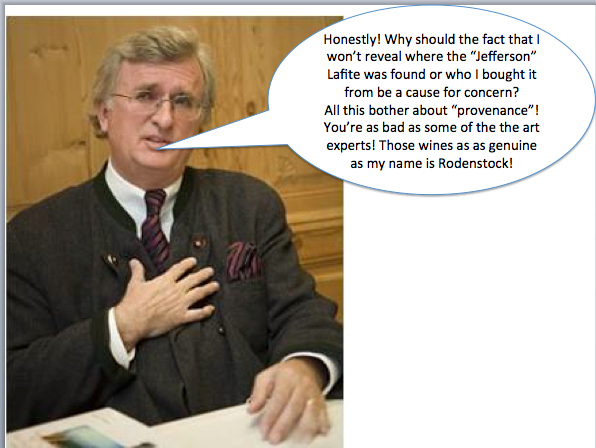
I never met Rudy Kurniawan, the man who was found guilty this week for faking much of the $35m - yes, that's $35,000,000 - worth of "fine" wine he sold at auction. But in the 1980s I did meet Hardy Rodenstock, the man accused of faking the "Jefferson" 1787 Lafite. At the time, I did not know that Rodenstock was not his real name (he was born Meinhard Görke) but when I mentioned his family relationship to the German spectacle firm of Rodenstock he did nothing to correct me. Far more significantly, I also asked him the obvious question of how he came to have amassed such an extraordinary collection of great old bottles, including huge numbers of rare magnums and imperials.


Hardy Rodenstock, the source of wine that supposedly belonged to
Thomas Jefferson

At first, he simply said that he had a fine nose and an unusually good network. When I persisted and suggested that he might not be unique in either respect, he looked at me directly and said "many of them come from South America". Hearing those words - the kind of Rodenstock "cryptic comment" referred to by Benjamin Wallace in his book The Billionaire's Vinegar - spoken in a Germanic accent sent a shiver down my spine. We both knew that there would only have been one way for large amounts of pre-war wine to have got to that part of the world. And that would have been as part of the looted treasure shipped there by Nazis fleeing Germany at the end of the war. For me at least, the notion that the rightful owner of one's glassful of sublime 1921 Petrus might have ended his days in Dachau somehow reduced its appeal. Others may have had fewer scruples.

In fact, however, despite my memories of movies like the Odessa File and the Boys from Brazil, I did not actually believe Görke/Rodenstock's explanation, because I'd already heard enough stories of Bordeaux chateau-owners quietly questioning among themselves the authenticity of the bottles of their wines he'd presented at his famous tastings. It seemed to me to be far more likely to be a case of confessing to a smaller sin in order to deflect attention from a larger one. 

That conspiracy of silence among producers about the faking of their wines was maintained for decades. It was only broken in April 25 2008 when, at a New York auction, the Burgundian Laurent Ponsot bravely stood up and said "those aren't our wines" to John Kapon of Acker Merrall and effectively forced him to withdraw them from the sale. Kapon's memorable reaction at the time was to say "shit happens". 


John Kapon had to remove fake Ponsot Burgundies from his auction at
the last minute after pressure from Laurent Ponsot. But, as he says, "shit happens"

The seriousness with which the head of that US auction house took the suggestion that he was selling fake Burgundy was illustrated by the fact that, despite talking to Ponsot over the phone about the producer's concerns before the sale, it required a transatlantic flight by the Frenchman for them not to go under the hammer. If Ponsot had not got on that plane, there is every reason to believe that a wealthy wine lover or "collector" (or both) would have paid serious money for wine that the auctioneer had ample reason to believe was fake. 

The wine that bothered Ponsot was consigned to Acker Merrall by Rudy Kurniawan who claimed (but only after pressure from Ponsot) to have bought it from an untraceable "Mr Hendra" in Indonesia. If it had not been for the separate efforts of Ponsot and a legal suit from billionaire Bill Koch in September 2009 claiming that Kurniawan had sold him fake wine - through the same auctioneers - in 2005 and 2006, it is questionable whether any alarm bells would have rung.
Billionaire collector Bill Koch tells court that 1% of 43,000 bottle cellar
are fakes - but that these represent 25% of the value

Bill Koch who is worth $3.8bn and stands at number 329 on the Forbes Rich List has expensively gone to court claiming to have been tricked out of hundreds of thousands of dollars by both Rodenstock and Kurniawan. This does rather put me in mind of Lady Bracknell. "To buy crazily overpriced wine from one faker may be regarded as a misfortune; to buy crazily overpriced wine from two fakers looks like carelessness". 

Which brings me to the nub of the matter. While westerners condescendingly talk of the crisis of fake wine in China and of the stupidity of the wealthy Chinese who fall for the bogus bottles, little has been made of the gullibility of the people on this side of the world who have parted with tens of millions of dollars on wines with no proven provenance. The auction houses too, are a little like the banks in the way that they seem to have escaped much of the opprobrium they deserve for their lack of professionalism.

Stated bluntly, "Rodenstock" and "Kurniawan" arrived out of the blue, splashed around money, frequented the rich, famous and wine-fixated, and remarkably quickly transformed themselves into geese - miraculous fowl that reliably laid large numbers of golden eggs in the form of great old bottles of wine. If they had suddenly begun to offer Picassos or Renoirs like my imaginary friend in the pub, I think someone might have cried fowl. But in the wine world, we prefer wilful ignorance.

Establishing the provenance of a bottle of Bordeaux is supposedly tougher than that of a painting. Artworks are all identifiably unique, as are watches (which carry serial numbers). Un-numbered bottles of wine are not - which raises the question of why the labels of all fine wines aren't numbered as a matter of course. Especially now that they often cost more than the timepieces.

Obviously, numbering current vintages doesn't solve the problems of the older bottles at the heart of the recent scandals. For those, anyone wanting to be sure of not being taken for a fool needs to be able to trace the progress of the bottle from the original cellar to the person who is offering it for sale. Where that's not possible - as in the case of a vendor who refuses to say precisely where and how he obtained the wine, a very big health warning should hang over the transaction. And over the auction house or merchant brokering the deal.

But maybe none of this really matters. Maybe the auctioneers, merchants and producers who have cashed in on the recent stratospheric rise in the price of fine wine all owe Rudy Kurniawan a debt of thanks. Until of course confidence is sufficiently battered for the house of cards to come tumbling down. It may never happen, of course, but you never know: in the words of John Kapon, "shit happens".