Tuesday, July 09, 2013

Wine, critics and science (pseudo, junk and real). Part 1


The Today Programme feature

Is wine assessment science? Pseudo science? Junk science? Are wine judges and critics "bullshit artists"? 

I got sucked into having to consider all these questions when I agreed last week to take part in a brief discussion on the BBC Radio 4 Today Programme.

The producers' decision to tackle the issue was sparked by an article by David Derbyshire in the Observer headlined that wine tasting was "junk science". Robert Hodgson, a US oceanographer and statistician-turned-winemaker, had, according to the piece, "proved" that 

"Only about 10% of [US wine] judges are consistent and those judges who were consistent one year were ordinary the next year....
Chance has a great deal to do with the awards that wines win."

Hodgson has been researching wine judging consistency since 2005, saw early results published in the respected Journal of Wine Economics in 2008, and then introduced to the wider world in the Wall Street Journal the following year. The Observer piece, which covers some - but not much - new ground has created a substantial amount of noise since its publication on June 23.


The June 2013 Observer feature that ruffled
so many feathers


The very similar piece from the WSJ in 
November 2009, that went largely unnoticed

Apart from Hodgson's findings, the Observer and WSJ also gleefully picked up on earlier research by a Frenchmen called Frederic Brochet into Gallic tasters' reaction to the same wine when it was presented under different labels. (They rated it more highly - and used more positive terms - when it was served as a Bordeaux than as a Vin de Table). Consumers, it was gleefully revealed, actually often prefer cheap wine to pricier fare.

As a further killer punch to the egos of wordier wine authorities, there was also reference to research questioning the physical ability of the human palate to pick out the large number of specific flavours that frequently appear in some critics' descriptions. 

Putting all of this together, Derbyshire concludes that "human scores of wines are of limited value."

Tim Atkin, in a robust response in Off Licence News and in his Timatkin.com blog, declared that "

"Wine tasting is not a science (or “junk science”, as The Observer would have it) because it is a subjective exercise."


and devoted much to questioning Hodgson's research. 

"We are not told how “expert” the experts who performed badly were. Are we talking a sommelier with a couple of weeks’ work experience in a steakhouse? Or an experienced show judge who assesses wines professionally for a living? The claim that they read like a “who’s who of the American wine industry” sounds questionable. In Sacramento?"

Good competitions - like the IWC of which he is Co-Chair - have, Atkin claimed, 
"tasters [who] are perfectly capable of judging 100 or more wines in a day and of tasting them with insight and knowledge."


In raising doubts over the quality of the Sacramento competition, Atkin is actually in good company. Leading US wine blogger Blake Gray recently wrote a Palate Press piece that was highly critical of that event - and other California competitions.

It's all too easy, however, simply to dismiss allegedly dodgy US wine competitions, cranky US statisticians, and sensationalist UK newspapers. But let's look at the picture from a more neutral perspective. The Observer piece attracted over 400 comments, most of which were favourable to its tone.


The story was widely covered elsewhere and the BBC thought it worth discussing in its flagship morning radio news programme. Maybe, just maybe, we might have to acknowledge that we wine people might be out of tune with rather a lot of the consumers who go out and spend their own hard-earned money on the stuff we care so much about.

Atkin refers to this specifically:

Features bashing wine experts with their “flowery language” seem to appeal for two main reasons: first, they enable some members of the British wine-consuming public to indulge the muddle-headed notion that cheap plonk is “often superior” to more expensive stuff (that deal-driven, lowest-common-denominator mentality that has done so much damage to average wine quality in the UK) and, second, to give vent to a deep-seated insecurity about their own senses, invariably expressed as reverse snobbery. “I know what I like,” etc.

He does not seem to want to accept any responsibility for this state of affairs. It appears to be the British wine-consuming public's fault for failing to understand what we are saying to them. Of course, Atkin is totally correct in talking about UK consumers' tight-fistedness but inconveniently for his argument, most of the elements of this story originated in the US and in France. The Wall Street Journal article was definitely not aimed at British readers.
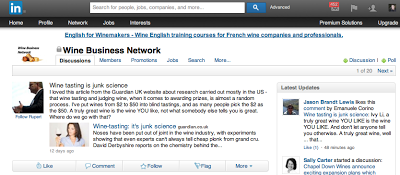
I was also struck by the sympathetic tone of contributors to more professional forums such as Linkedin's Wine Business Network


Wine tasting may not be a science, but I'll break ranks with many wine writers by saying that I agree with the basic theme of the criticisms: wine assessment and the way wine is written about do lay themselves wide open to accusations of being pseudo-scientific.

Let's start with so-called Parker Points. Giving a wine 89 or 90 or 91 points implies considerable precision, especially when, as we know, the side of the 90-point line on which a wine sits can have a huge impact on its marketability and the price it can command. (17.5/20 implies similar precision - and actually involves it if one considers that users of the 100-point scale rarely dip below 79 and those who prefer rating out of 20 treat 10 as their floor).


To the annoyance of many in the wine world, points have been welcomed both by consumers who find them an invaluable route through the wine jungle, and by producers and distributors who use them to drive sales.


But, as I've often been asked by consumers, how does a critic arrive at a mark of 89 rather than 90, say? The OIV competitions attempt to give structure to their scoring process by requiring judges to indicate the number of points they have allocated for colour, nose, typicity and so on - but they still allow a margin for tasters to show gut-preference. Besides, like many other OIV tasters, I'll admit to coming up with the mark first and filling the category numbers afterwards - just as most critics do when giving their "Parker" point. 

However they arrive at their mark, in theory at least, trained palates should achieve some level of consistency - and they often do. But it's far from absolute. Robert Parker admitted (to the author of the WSJ piece) that his marks for the same wine can deviate by two or three points, and it's a rare taster who'd stake anything of value on greater consistency than that. But three points on a scale that runs from 70-100 sounds very much like an error-rate of 10%. And when the variable is applied to wines getting 85-100 (which is likely to be the case), it's a lot more significant.

As some of the people who responded to the Observer article pointed out, there is a long list of reasonable explanations why even the most skilled and experienced taster might give - possibly widely - different marks to the same wine. Let's consider just a few of them:

  • The place and time. A wine may unsurprisingly seem very different when sampled in the producer's cellar to the way it tastes in a blind line-up in a competition. A few weeks can also have an effect on a wine's evolution, especially when it is young. (Think of all the variations between en primeur tasting notes written in early April and when the same wines are presented in June at Vinexpo.)
  • The time of day. A wine tasted at 9am, shortly after breakfast might be rated differently by a hungry taster at 1pm, or by one who has just enjoyed lunch at 2.30.
  • Physical state. The taster's state of tiredness, stress or physical health. Zinc deficiency, for example, can lead to a condition called Dysgeusia - "a distortion of the sense of taste" - often associated with complaints of foods having a a metallic taste. Patients undergoing chemotherapy frequently complain of their palates going awry. This Japanese piece of research reveals that physical exhaustion lowers the sucrose-perception threshold. The researchers on that occasion worked with athletes who'd run a half marathon, but some of the same effects might well be found in a taster who's had a sleepless night dealing with a young baby, for example. Another - US - study found that stress increases the perception of bitterness. Further causes of "bitter-taste-in-mout" include, acid reflux disease or GERD, Hiatal Hernias (or other hernias), tooth decay or gum disease, Achalasia (a condition that affects the oesophagus), H. Pylori infection (an extremely widespread bacteria that may infect around two-thirds of the people in the world), Oral Cancers, Aspiration Pneumonia and syphilis.
  • Mood. Happiness, sadness, fear and anger can affect the way we perceive taste. According to a Los Angeles Times article,

    G
    iven a neutral-tasting shot of diluted blue Gatorade, participants in a study in press at the journal PLoS One thought the beverage tasted more delicious after reading about someone being morally virtuous and more disgusting after reading about a moral transgression.

  • Time of the month. In the case of women, their menstrual cycle or pregnancy can affect perceptions of taste (the higher the levels of oestrogen, the lower the sucrose threshold)
  • External distractions
  • The position in a line-up
  • The temperature of the wine
  • The length of time the bottle has been open
  • The glass from which it is tasted (if you are to believe Georg Riedel's blindfold demonstrations)
  • Shipping. The old notion that some wines "don't travel" may have some validity. (New Zealand wine authority Bob Campbell addressed this issue last yearDr Neill McCallum, founder of Dry River Wines in Martinborough, New Zealand. McCallum, who gained his PhD at Oxford studying the relevant branch of chemistry, theorised that movement through travel breaks the hydrogen ions in wine resulting in muted flavour and aroma. Hydrogen ions do re-form, although not completely, according to McCallum, resulting in partial recovery of aroma and flavour when wine has a chance to recover after travel. He also notes that damage to hydrogen ions is significantly lower if the wine is cooler, supporting the case for shipping wine in refrigerated containers.
  • Lunar cycles. If you believe in biodynamics, the calendar is divided between four different kinds of day, depending on the lunar cycle. 

Some of these are apparently more propitious for planting than for wine tasting. It's easy to dismiss this as superstitious nonsense, but listen to Jo Ahearne MW, a trained winemaker who was employed as a buyer by Marks and Spencer in the UK: 

"I was sceptical at first, but then had a eureka moment," says Jo Aherne, winemaker at Marks and Spencer. "Our wines showed beautifully at a press tasting one day and far less well the next. We couldn't understand it. The wines were all favourites of ours and the bottles were all from the same case. Someone checked the calendar and we found that the first day had been a fruit day, when the wines were expressive, exuberant and aromatic, and the second a root day, when they were closed, tannic and earthy. Further rather unscientific tests have confirmed our view."


Ahearne is not alone in her belief: other UK retailers now avoid root days when inviting critics to taste their wines. Wine competitions have a trickier task, however. The IWC runs across two weeks - that could involve a lot of fruit and root days.


  • Altitude. It is acknowledged that foods and drinks taste different in airplanes, but that might be because of the lack of moisture in the cabin air: wines in particular seem to taste more tannic and more alcoholic. As a 2010 German study found,
"Light and fresh flavors decreased, whereas intensive flavors persisted"


But the altitude itself may have a role to play. Another study - published by Maga JA, Lorenz K.in the  US National Library of Medicine National Institutes of Health - suggests that from 5-10,000 feet, people become more tolerant to bitterness.


  • Barometric pressure. If altitude affects taste, so, logically, might the weather on the day the wine is tasted.
  • Humidity - or lack of it. The dry conditions in airline cabins are widely blamed for numbing tastebuds.
Okay, let's assume that none of these factors applies to the two bottles in front of us. Let's say that they were both bottled from the same tank on the same day, were pulled out of the same carton and poured into a pair of identical glasses to be tasted alongside each other. They should consequently taste the same - and receive the same marks from a competent taster. Shouldn't they?

The day I really lost my faith in the usefulness of specific wine ratings came late in 2004. I had been asked by a big bank to talk at a dinner to a large roomful of its guests about a set of very classy Italian wines. There were a dozen bottles each of examples of Ornelaia, Solaia, Sassicaia, Biondi-Santi, Gaja, Maculan and Jermann. (This was back in the days when banks threw their money around pretty freely.)

As usual, I pre-tasted all of the bottles for cork taint - and found a couple that showed clear signs of TCA. Two litres of sour milk out of 80 or so bottle, or a couple of bad eggs in a dozen cartons would be a cause for concern, but in the crazy world of wine, the sommelier at the venue and I shrugged off this level of faultiness in highly costly reds and whites, as par for the course. Far more concerning to me, however, were the more subtle variations I encountered in the other wines. When tasted really carefully - something wines of this calibre deserved - there was only one set that were truly 100% consistent: the Gajas. All the others included at least one or two bottles that tasted different enough from the others to warrant the addition or removal at least a point or from their score. 


Now - and this is important - I'm not claiming any exceptional tasting skills. Far from it. In fact, I tested my belief in the irregularity of the bottles by setting up a few three-glass tastings for the sommelier and an enthusiastic waiter. Even without any experience of the wines we were looking at, in three of the four instances, they had little difficulty in spotting the odd man out.

All the bottles were sealed with natural corks and I suspect that the poorer examples almost certainly suffered from very low level TCA or random oxidation - both of which flatten flavour, It is harder to explain the outstandingly better bottles. I suspect that particularly "good" natural corks may have provided optimum oxygen ingress plus possibly, that rarely discussed factor: "gout de bouchon" - the subtle flavour of non-tainted cork oak.

I was, naturally, aware of bottle variation before that day, but the experience was, as I say, faith-shaking. How many readers of my recommendations were sipping their freshly-bought bottles and shaking their heads saying "I've got no idea why he was so impressed by this."?

This naturally leads me on to one of the anomalies of wine competitions. I have chaired or co-chaired over 50 International Wine Challenges and other similar events across the globe and judged at dozens more. One of the things all these contests have in common is the encouragement to tasters to call for a second bottle if they have doubts about the first. On occasion, a third bottle can be requested.

Sometimes the call is easy: a wine reeks of TCA, vinegar or sherry. All too often, however, it's more marginal. Tasters discuss whether it's worth pulling another cork (or unscrewing a cap). Sometimes the second bottle is substantially better (or worse). In those cases, it is the good one that is judged and quite possibly given a gold medal. 

It's as though the judges at Wimbledon decided that perhaps Federer and Nadal weren't really playing at their best this year and deserved to be allowed another match to see whether they deserved to stay in the tournament. Or a restaurant critic giving Michelin stars to a restaurant where she has had to return a badly cooked dish.

At this stage of my fairly lengthy career, there is one thing of which I am sure. Every "Parker point" or medal, or media review represents the result of a single event: a single encounter or, possibly, in the case of a competition, a rapid succession of encounters with one or a small number of humans. It is not and cannot be definitive. Was Sabina Lisicki a 100-pointer in her losing-in-straight-sets Wimbledon final? Maybe not. But what if the clock had stopped 
on the day she'd beaten Serena Williams. At the final, it was Marion Bartoli who got the magic score. Are either of these players really greater than either Williams sister?

So yes, critics are bullshitting if they pretend that the mark or medal they give a wine on any given day has the quality of a verdict from the Supreme Court. And the wine world is guilty of pseudo science when it talks of a 95-point or trophy-winner as if that non-scientifically awarded mark or prize defines it in a permanent fashion. The truly great wines - like the truly great sportsmen, actors, singers, artists and authors - are the ones that consistently impress a number of credible critics.


Thursday, June 27, 2013

Brief thoughts about Vinexpo

In response to a few requests, here are a few brief thoughts about - and images of - last week's Vinexpo.

Before doing that, however, maybe it's worth my providing a little personal background - and some context (please do feel free to skip this bit). I've been going to Vinexpo for so long that I can remember the vigorous debates of the early days over whether the fair should be limited to Bordeaux, or France, or whether - and this was highly controversial - wines from other countries should be allowed within its doors. Having attended the exhibition since the early 1980s and generally having been around for a long time almost inevitably means that I know a lot of the people who I'm likely to see there, so the show offers a great opportunity to catch up with them. Finally, since 2005, when I crossed the line from consumer wine-writing to wine production and industry analysis, I have viewed these events in a different way, with less of an obsessive focus on the quality of the liquid on show, and more of an holistic appreciation of the business as a whole.

Striking advertisement for a dynamic, multi-country
brand

2013 was a "quiet" year. There was little real buzz about anything really. In 2011 at the previous event, there was 2010 and 2009 Bordeaux to talk about; this year, there was 2011 and 2012 not to talk about. Two years ago, China was still "hot". Now it is generally considered to have come off the boil. 


Chinese spirit stand - one of the biggest in the whole fair

There were plenty of Chinese visitors, but they are now more of the mainstream of the event: they are no longer as exotic as they were.

The show felt very "French". There was no Australian stand (since the year when the air conditioning failed and the wines were cooked) and the other New World stands did not make a huge impact on the fair as a whole.

There was little that was new. NPD - New Product Development - was notable for its absence, with the exception of Amorim's screw-in Helix corks.

Giant sculptures - and umbrella-wielding Vinexpo-goers
heading across the bride over le Lac


And of course, it was rainy. Very rainy. Tropically rainy at times. This meant that there were fewer people outside the fair - and also revealed how much quieter - in numerical terms - Vinexpo 2013 was. Visitors to previous events will remember the nightmare of trying to make one's way along the crowded aisles from one end of the hall to the other. The only sensible way to do this was to leave the building. Not this time. The building was definitely less full.Vinexpo's statistics may not reflect this, but the anecdotal evidence is clear: the car park was far less full, and it took far less time to queue for a sandwich at lunchtime. Hotels reported late cancellations, and had rooms for those who wanted to book one at late notice.

Despite all of this, logistics remain a nightmare. Negociating the traffic in the morning or getting out of the car park can take what seems to be a lifetime. There were, however, signs that Bordeaux's famous trams will reach Vinexpo in two years time, finally making the exhibition as easy to get to and from as Messe Dusseldorf is from its city centre.

Russian vodka stand. On occasion manned (!) by
 - slightly - more dressed ladies than the ones in
the posters

If there were fewer people, there was no suggestion that the "right" people were not there. The exhibitors I talked to were all happy with the meetings they had.

However, there were many questions over the duration of the fair. My humorous suggestion that Vinexpo could lose two of its five days and give one to ProWein (which currently runs for three) was taken surprisingly seriously.

In a nutshell, ProWein is now undeniably the business event, at which the real sales are made. Vinexpo remains the networking event - the one at which the principals of businesses are more likely to appoint agents and discuss mergers and acquisitions.


Poster on road away from the fair. Traffic
allowed plenty of time to take down that number


Frightening travel facts


1)  There is a one in 253 likelihood that the hotel bed you are going to sleep in tonight still has the sheets that were slept in by the previous occupant. Astonishingly, the chances of this happening are far higher in 3* and 4* hotels than in motel chains.


2) There is a one in 371 chance that the brakes on your hire car will be faulty.


3) An average of two passengers on every transatlantic flight will have to wait over three hours to get their cases. One passenger in every two of these flights will lose their bags for ever.


.

4) One in every 428 fish dishes served in European restaurants will smell so stale as to be inedible.

5) One in every 946 female visitors to Rome is subject to at least some form of potentially unwelcome male attention.

Don't these statistics put you off the very idea of travel - however romantic? 

Fortunately, only one of them has even a grain of truth. Italy is the homeland of Silvio Berlusconi after all. The others are all made up.

But... most of the wine world still puts up with far, far worse statistics than this. I opened 150 bottles of premium Portuguese wine for tastings at Vinexpo. Eight were spoiled by bad corks. The day before leaving for Bordeaux, I ran a tasting of Grand and Premier Cru Burgundies for the Antique Wine Co in London. We had to open a second bottle of the 1999 Vosne Romanée 1er Cru Cuveee Duvault-Blochet from the Domaine de la Romanée Conti (average value on wine-searcher: £544). Yesterday, Keith Prothero, director of the Sampler, one of the UK's most dynamic wine merchants posted on Facebook that "Shame. A very generous guy brought a 2000 La Tache to lunch today,only to find it was corked !!!!" (Value: £1600).


Then there was the magnum of La Louviere 1990, a couple of weeks ago... Do I need to go on?

The wine closure debate is a bit like politics in the Middle East: it's been going on for so long that everyone has either taken an entrenched position or is too bored by it to make a contribution. But, like the Middle East, the problem isn't going away.

I don't happen to believe that screwcaps are the answer. I think they are AN answer. As are Diam and Nomacorc and VinoLok. All of these are a better idea than natural corks. 
.


I might even be persuaded to believe in Amorim's new Helix, screw-in cork, if it were not for the struggles I've had with too many of the other things that company have said and done over the years.


I actually have a better reason to comment on these matters than some. Our le Grand Noir whites and Pinot Noir are currently under screwcap; the other reds are under cork because our US and Chinese importers insist on it. We have previously sealed the same wines with Nomacorc and - briefly - screwcaps, but, like many, many other producers, and like the Domaine de la Romanée-Conti and Penfolds, we are for the moment at least being forced to give consumers what the wine industry has told them they should have: the ever-present possibility of disappointment.


Monday, June 24, 2013

Requiem for Slurp. What lessons do the collapse of a glitzy online wine retail website have for UK independents..?


Slurp's current listing on Google

A couple of years ago, I carried out a little research among UK independent wine retailers asking them what concerned them most in terms of competition. The most widespread fear at the time seemed to lie in the form of one company: Slurp.com. A pure-online business with ambitions to offer a comprehensive range of wines (it claimed to be the "largest online retailer"), it seemed to offer everything that all those indies would have liked to be able to do themselves.

The Slurp home page

Some of the more ambitious wines on the
Slurp website


It had a smart website and £15 Italian Pinot Biancos and £16 New Zealand Chardonnays, aspirations to sell "fine wine" and, best - and most frighteningly - of all, backing from a company called Aspiration Capital Management. Underlining the philosophical kinship Slurp had with the indies, Slurp's CEO, Jeremy Howard was quoted in a Drinks Business piece as saying that  “The consumer online wants a focused experience, not a supermarket experience... We don’t fear the supermarkets.”


The profile - in June 2012 - suggesting that Slurp was leading
a UK wine retail revolution

The video channel


Unquestioning coverage from another UK publication
of the shift into fine wine

How things change... The Drinks Business coverage
of the acquisition of the "troubled" company


Mr Howard may look back on that comment ruefully. Today, his UK business has collapsed and been sold by the administrators, along with what Greg Shaw, commercial manager of the purchaser, EH Jones, described - in another Drinks Business piece - as "a small amount of wine for immediate delivery".

Shaw went on to say that "Slurp had been growing its sales and customer base but was unable to trade profitably in the UK... [the company] had worked very hard to build up its business over time and, although it was building up sales, its overheads were running ahead.”


Wednesday, June 19, 2013

The parallel universe of wine

(in which there is an Empress of Wine.)
A column that previously appeared on timatkin.com
.Roberta Parker
The most influential voice in the parallel wine world is Roberta Parker who regularly appears on television demonstrating how to choose wines to go with particular dishes, how to serve them, how to prepare wine cocktails, what to do with left-over wine and how to choose the best wine glasses. She also pays close attention to the aesthetic appeal of the labels and the practicality of the packaging (she loves screwcaps and hates having to carry heavy bottles back from the shops). Wine merchants across the world sell wines using Ms Parker’s food recommendations, but many French and British wine professionals disagree with her tendency to marry wines with T-bone steaks and her preference for large wine glasses. Roberta Parker does not like wines with high calorie or alcohol content and she could not imagine giving them “points”.
In a parallel universe 2 
(In which the French wine establishment gets to run the French motor industry)
It was decided in 1963 to hand over the responsibility for the French automobile industry to the Institut National des Appellations d’Origine Controlée.
The new Renault 444 has air conditioning and airbags, but it still looks like this
Renault 444
And it still has the characteristic gearshift:
Renault 444 interior
Any proposed new designs have to be authorised by the Minister of Transport. There is no chance of Citroens or Renaults changing

Wednesday, June 12, 2013

The madmen who hold the strings of the French wine industry

.


Professeur Reynaud trying to hold back the waves
of social media


These are busy times for the lunatic fringes of the French wine industry. First, there is the revival of the 2009 plan to ban the blending of red and white to make rosé anywhere in Europe. (Apart from Champagne, presumably).


Then there was the proposal - by Professeur Reynaud* in a report to the French government on Les stratégies validées de réduction des dommages liés aux addictions (valid strategies to reduce the damage caused by addictions) that internet promotion of wine be no longer authorised, particularly through social media.

Setting aside the worrying state-control-of-media flavour of terms like "authorise", there is also the question of how precisely the good Prof thinks he is going to achieve this particular objective. Will he ban French wine producers from having websites? And will he also ban websites "promoting" restaurants and wine museums that belong to wineries? Will he ban winery owners from having their own websites and blogs, or will he simply censor any mention of the evil alcohol from their contents? Will he take Chinese-style steps to block Gallic access to sites and blogs hosted on non-French servers? Will Twitter and Facebook be similarly censored? And will website addresses and QR Codes be banned from labels?

There is an online petition to combat the Reynaud plans, and you may feel you'd like to sign it. https://www.change.org/fr/p%C3%A9titions/sauvons-le-droit-d-expression-de-nos-vignerons On the other hand you may prefer to simply watch it wither and die...

******
*King Canute - or Cnut - is the 10th century king who is said - probably erroneously - to have tried to hold back the waves. Prof Reynaud is a psychiatrist and head of the dept of psychiatry and addiction at the Paul Brousse University-Hospital. 

worst wine ad?


Is this the worst wine ad you've seen in a while - from a June 2013 Portuguese wine magazine? Or can you offer something worse?

Monday, June 10, 2013

Twitter's new baby - Vine - and a novel way to promote (or explain) wine


If you haven't seen it, you might be interested to see this brief presentation on how to use Twitter's new baby - Vine - to market wine.

The hashtag #wineonvine was too good to miss

No country for old wines: how Robert Parker & the "natural" wine movement are threatening the wine world


.

Okay... Today's tricky wine question is:

What does Robert Parker have in common with the "natural" wine movement?

Until about five minutes ago, I'd have found this a really tough one to handle, but now I have an answer whose implications have begun to rattle around in my brain.

Over the last three decades, the sage of Monkton, in common with other US critics, has been accused of fostering the market for, and the production of, ripe (some would say over-ripe), sweetly vanilla-oaky and alcoholic, immediately-appealing, young wine. Many of today's generation of wine drinkers have rarely if ever experienced older bottles and do not like it much when they do so. I can think of several tastings and dinners I have run at which the majority of people present greatly preferred vintages such as the 2005 and 2000 to the 1982 and 1990. Where, they asked, was the fruit in those older wines? It is hardly coincidental that recent vintages command higher prices than old ones.


Now, at first sight, the fans of "natural", low-SO2 wines seem unlikely bedfellows for Parker, Suckling et al. After all, they would rather go thirsty than drink some of the latter group's 100-point young Napa Cabs. But the naturalistas, in their own way represent even more of a challenge to those of us who, at least occasionally, relish the flavour of wine that's 20 or 30 years old. (And I'm not necessarily talking about great wine here).

Wednesday, June 05, 2013

Sympathy for the devil. A few words on behalf of sulphur dioxide.


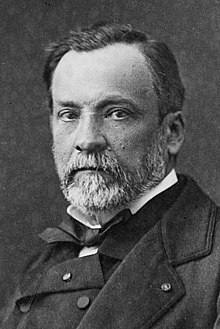
Louis Pasteur - the increasingly forgotten
man of the modern wine industry

"And the devil that deceived them was cast into the lake of fire and brimstone, where the beast and the false prophet are, and shall be tormented day and night for ever and ever."


"And the devil, who deceived them, was thrown into the lake of burning sulfur, where the beast and the false prophet had been thrown. They will be tormented day and night for ever and ever."


I am indebted to biblehub.com for providing these two versions of Revelations 20:10. They are very similar - apart from the notable replacement of "fire and brimstone" with "sulfur". It may be coincidental, but the use of the chemical rather than the poetic name quite vividly illustrates the way that sulphur (to use the English spelling) has been increasingly demonised in recent years. 

For a very distinguished Spaniard I met a few weeks ago, sulphur dioxide was responsible for what he evidently believed to be the recent decline of Spanish wine. Until 1978, he said, no-one in Spain used the chemical. 

Answering him felt a little like telling a sophisticated adult that the world was not, in fact, flat. Sulphur dioxide has been used by winemakers for a very long time. The Romans burned sulphor to clean the interiors of their amphora and as a preventative against the bacteria that would turn wine to vinegar. That practice almost certainly continued over the centuries, and it was given the royal seal of approval in 1487 by the King of Prussia around 125 years before the publication of the King James Bible.

In 1864 Louis Pasteur proved that micro-organisms were responsible for both fermentation and a wide range of spoilage. Dairies across the globe learned valuable lessons from Pasteur about desirable and undesirable micro-organisms, and brewers learned how to get positive results for particular beer styles by careful management of potentially negative organisms such as Enteric bacteria, Kloeckera apiculata, Lactic acid bacteria and Brettanomyces.

But the message took a long time to penetrate much of the wine industry. Over the years, I have visited wineries in which hygiene was quite obviously a very foreign concept. When the "flying winemakers" first went into European wineries on behalf of UK and US buyers, they often said that much of what they had to do involved simply focusing on cleanliness and grape ripeness. These were the "good old days" before "industrial" winemaking allegedly introduced "blandness" to European wine. 

I can look back at that time without the use of rose-tinted glasses. I remember cooperatives scheduling harvest delivery dates on the basis of their members' names. Alberto Aranjuez would pick his grapes on September 1st while his neighbour  Ziggy Zenovia would have to wait until the 14th. Irrespective of the maturity of either of their crops. Growers who arrived with their grapes at noon would see them oxidize in the midday sun as the winery downed tools for lunch. Work also stopped at weekends. One flying winemaker reported having to break into the bodega where he was overseeing the fermentation of wine for a British supermarket. "They wouldn't give me a key and I wasn't going to leave my vats to their own devices for 48 hours".

Cleanliness was often rudimentary. I met another Australian who was working at a cooperative in south west France during a particularly tricky harvest. Relations with the directeur were not good, he explained. There had been an argument over the need to rinse the hoses, with the co-op boss claiming that "the wine washes them; there's no need to do it with water". To prove his point, the Aussie had found a dead rat ("there were plenty of those") and quietly stuffed it into the end of one of the hoses just before leaving the winery for the night. Next morning, he persuaded the directeur to check the hoses with him and, naturally, "when he picked one up, the rat fell out, straight onto his face".

Most wineries now are far more conscious of the need for hygiene, but the science still seems to be fairly rudimentary, at least when set against other beverages. It is not so long ago that I was given a French Syrah to taste by its producer. What do you think of it? he asked. It's good, but a bit reduced, I responded. Affronted, the grower, said "Non! Il renarde un peu, c'est tout", If you're not familiar with the French verb renarder, nor was I because it fails to feature in my dictionary. I think it means "to fox" or "be like a fox". I know about winery cats, but I 'm still unclear over how foxes fit into Gallic vinification methodology.

Most winemakers seem to know far less about brettanomyces than their beer-making counterparts and, given the nonsense that is talked about the irreplaceability of natural corks, remarkably few appear to be aware that modern closures - Nomacorc, Diam and screwcaps - all now offer controlled versions of the uncontrollable oxygen ingress traditionally associated with bits of cork bark. Wine professionals bang on about "minerality" but as this Wine-Searcher piece illustrates, there is little scientific support for the term having anything to do with the soil in which the grapes are grown. Jamie Goode revealed in a fascinating blog post that the smoky/gunflint "pierre-à-fusil aromas positively associated with some French wines is actually caused by the presence of a sulphur compound called benzenemethanethiol

Which brings me back to that old devil, sulphur - and the drive towards producing wine with little or no SO2. My comments about "natural" wines in previous posts and elsewhere has - quite reasonably, if not entirely accurately - given me a reputation as something of an enemy of that movement, and a sulphorphile. My argument is actually against the term "natural", the holier-than-thou attitude of too many of its supporters, and, most firmly, the sheer amateurishness of much of the winemaking, and the faults that this unsurprisingly engenders.

Believe it or not, I actually welcome the reduction of additives in wine - and would be delighted to see ingredient labelling, as pioneered by the Co-Op chain in the UK and by Ridge Vineyards in the US. Having been very impressed by the quality and reliability of Gerard Bertrand's Naturae range of Zero-SO2 wines, I'm even looking at producing an unsulphured version of our Greener Planet wine this year.

Like Bertrand, and some of the best Zero-SO2 "organic" producers in the US, we're not, however, going to do that without taking a very careful look at how we are going to end up with a wine that is stable and reliable. Like Betrand too, we'll print a "best-before" date on the label, allowing two years or so of cellaring. 

On the other hand, would I consider omitting the brimstone from a premium wine that might benefit from a decade or so of patience before being opened? No way. The finest wines I have ever drunk have all owed their survival over decades to SO2. When I raised the issue of longevity with "natural" wine fan Alice Feiring, she replied "who cares" and directed me to old bottles of Chateau Musar. Having just sampled a cloudy, volatile 2000 Musar, all I'll say is that I can think of a long list of other 2000s I'd rather drink.

But 2000 is a long time ago. As Doug Wregg, director of sales and marketing, of UK distributor Les Caves de Pyrene, and one of the strongest leaders of the "natural" movement was quoted as saying in the drinks business. "60-80% of natural wine should be drunk within the first year, after that they fall apart... Most of the wines are light, pale, fizzy and fun. They’re meant for wine bars rather than cellars... It’s a miracle when something lovely happens in the bottle a few years down the line, but I wouldn’t bet my house on it”. Neither his, nor mine.

**********
For anyone interested in knowing what we will be looking to avoid in our unsulphured wine may be interested in this, from an article in Wynboer by Heidi Schoeman of SunBio, Institute for Wine Biotechnology, Stellenbosch University

Uncontrolled microbial growth during and after the fermentation of wine can change the chemical composition and ultimately the quality of the end-product. Strains of lactic acid and acetic acid bacteria are usually involved in wine spoilage and can lead to ropiness, volatile acidity, acrolein formation and bitterness, tartaric acid degradation and geranium off-flavour (Du Toit and Pretorius, 2000). Certain strains of lactic acid bacteria (LAB) can also produce biogenic amines and ethyl carbamate precursors. Despite the significance of LAB in malolactic fermentation, it is important to control the presence of naturally occurring LAB in a winemaking environment. 


Sunday, June 02, 2013

The Natural Wine Debate revisited


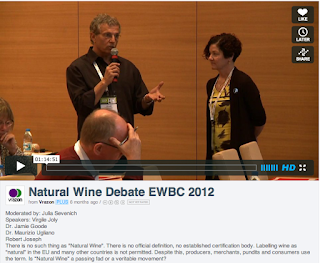
My two posts on "natural" wine have sparked some responses, so I thought it might be worth posting my - deliberately provocative: it was a "debate" after all - presentation at last November's EWBC, together with comments from my fellow panelists Virgile Joly, Jamie Goode and Maurizio Ugliano and from audience members like Alder Yarrow, Blake Gray and Arnold Waldstein.


And for those who feel up to it, here's the full-length version, with all four presentations.